 listicle
Is a Commercial HVAC Maintenance Service Worth It?
Last Updated: October 29, 2026
Quick Summary
A commercial hvac maintenance service is worth it when the annual contract fee is lower than the emergency repairs and early replacements it prevents. Facility teams managing mid-size commercial buildings spend $18,000 to $65,000 a year on HVAC maintenance, so the contract only pays off when it covers real work: scheduled inspections, seasonal tune-ups, priority response, and written records of every visit.
- Standard office space needs two full service visits per year; restaurants and kitchens need quarterly maintenance.
- A regular maintenance visit per system usually runs $150 to $500 depending on system size.
- Demand a stated emergency response window with penalties and a named contact, not a call center.
- Check filters monthly for the first quarter; if they load in under 30 days, the visit schedule is too light.
- Ask for proof of general liability and workers' compensation coverage, and confirm it renews.
Table of Contents
- What a Commercial HVAC Maintenance Service Actually Delivers
- Provider Comparison: Commercial HVAC Maintenance in Rhode Island
- The Commercial HVAC Maintenance Checklist Every Contract Should Cover
- HVAC Maintenance Frequency for Businesses: How Often Is Enough?
- HVAC Service for Property Managers: What to Demand From a Vendor
- Cost-Benefit Analysis: What a Service Contract Really Saves
- Book a Commercial HVAC Assessment With T. Gomes Heating & Cooling
- Frequently Asked Questions
What a Commercial HVAC Maintenance Service Actually Delivers
Commercial HVAC maintenance is a scheduled service program that keeps heating, cooling, and ventilation equipment running through inspections, cleaning, adjustments, and repairs before failures happen. A 2026 pricing analysis from Oxmaint's commercial HVAC cost benchmarks reports that facility teams managing mid-size commercial buildings spend $18,000 to $65,000 a year on HVAC maintenance.
At T. Gomes Heating & Cooling, we have served commercial clients since 2013, and the honest answer is that a contract only pays off when it covers real work. A good program includes:
- Scheduled inspections of belts, filters, coils, and controls
- Seasonal tune-ups before heating and cooling peaks
- Priority response when equipment fails
What separates a useful contract from a folder of invoices is documentation: what was checked, what was adjusted, and what is nearing replacement. To see how far our commercial work extends beyond routine service, review the full scope of our commercial HVAC services.
Provider Comparison: Commercial HVAC Maintenance in Rhode Island
Rhode Island businesses have several maintenance options, and the differences matter more than the marketing. The U.S. heating and air-conditioning contractors industry reached a reported $159.4 billion market size in 2026, according to IBISWorld's industry estimate, so plenty of providers compete for your contract.
| Provider | Best For | Standout Strength | Watch For |
|---|---|---|---|
| T. Gomes Heating & Cooling | Businesses wanting maintenance, repair, and installation from one licensed team | Full-spectrum service, licensed and insured since 2013 | Pricing quoted per property |
| Atlantis Comfort Systems | Buyers who want a written quote first | Free written quotes with a price breakdown | Plan details not published |
| Energy One | Sites needing HVAC plus plumbing | Customized maintenance schedules | Plan inclusions not listed |
| Ocean State Air | Online service requests | Dedicated commercial maintenance program | Task list not specified |
| Aero Mechanical | Operators planning upgrades | Works on existing commercial systems | Maintenance plans unclear |
| HTS | Repair-heavy sites | Rhode Island repair staff, parts on hand | Repair focus, not programs |
| CARJON | One-stop heating and cooling | Maintenance alongside repair | Plan terms not published |
| Prime HVAC | Installation and repair | All three core service types | Pricing not published |
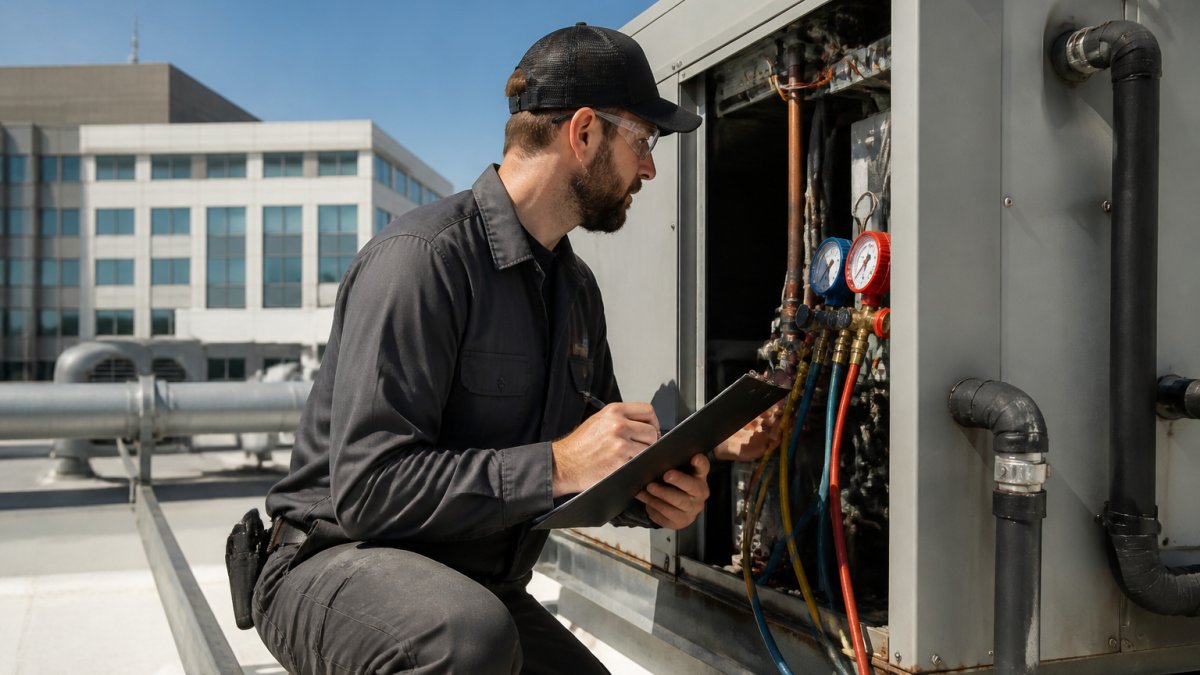
T. Gomes Heating & Cooling provides maintenance, repair, and installation services as a licensed and insured team. Review the complete range of services we offer before you decide.
The Commercial HVAC Maintenance Checklist Every Contract Should Cover
A commercial HVAC maintenance checklist is the list of tasks a technician performs at each scheduled visit, and it should be written into the contract, not left vague. If your agreement does not name the tasks, you cannot tell whether you received them.
Every contract should include these line items:
- Filter replacement or cleaning on a defined schedule
- Belt inspection and tension adjustment
- Coil cleaning on evaporator and condenser units
Ask for the task list in writing before signing, and compare it against our HVAC maintenance offering.
HVAC Maintenance Frequency for Businesses: How Often Is Enough?
HVAC maintenance frequency for businesses depends on equipment age, occupancy, and dust load. Equipment age, occupancy, and dust load shift that schedule. The useful question is not "what is the standard?" but "what does skipping a visit actually cost me?"
Here is a practical baseline, with the driver behind each cadence:
- Standard office space: two full service visits per year. Low dust load, steady occupancy, predictable runtime.
- Restaurants and kitchens: quarterly. Grease and cooking effluent coat evaporator coils and clog filters far faster than office dust, and a fouled coil drives compressor head pressure up and efficiency down.
- Medical, retail, and other high-foot-traffic sites: quarterly filter changes minimum, with coil inspection at each visit. Higher occupancy means more airborne particulate loading the return side.
The cost of stretching visits to annual
The cost of skipping visits shows up as emergency repair bills, not on the maintenance invoice. A 2026 industry analysis cited by ConsumerAffairs' HVAC market coverage projects 7.4% annual growth in the HVAC market from 2024 through 2030, and rising equipment costs make premature replacement expensive.
Run a simple comparison on your own building. Multiply your per-system visit cost by the number of visits you are considering, and set that against:
- One emergency repair call after hours.
- One compressor or condenser fan motor replacement, which can exceed the annual cost of a maintenance contract on a small system.
- One lost business day if a tenant-facing space loses cooling in summer or heat in winter.
The number to test is the cost of a single avoided after-hours failure against the year's visits, not the invoice line.
What changes the schedule
Three variables move the cadence more than anything else:
- Filter loading. Check filters monthly for the first quarter of a new contract. If they load in under 30 days, the visit schedule is too light regardless of what the standard says.
- Coil condition. Ask whether the technician will photograph coil condition at each visit. Visible fouling at the next visit means the interval is too long or the cleaning task is being skipped.
- Refrigerant history. A system that needed a top-off last season is a leak candidate. That system needs leak inspection at every visit, not an annual check.
Frequency only helps when the task list at each visit is defined, which is why the checklist section above matters as much as the calendar.
HVAC Service for Property Managers: What to Demand From a Vendor
HVAC service for property managers has to solve a different problem than homeowner service: you answer to tenants and owners at the same time. A furnace failure in February is your phone call, not the vendor's. The vendors that make your job easier are the ones whose contracts are written to be enforced, not just signed.
Demand these terms in writing:
- A stated response window for emergencies, with penalties if missed. "Priority service" is not a term, a response window is. Ask for a defined number of hours for after-hours response and a defined number for same-day dispatch during business hours, and ask what credit applies if the window is missed.
- One named contact, not a call center. You want a service manager's direct line and a backup name. A dispatch queue that reroutes you every call is a sign the vendor has not assigned your account.
- Reports you can forward to owners without rewriting them. The report should name the equipment, list tasks performed, note findings with photos where relevant, and flag items nearing replacement with an estimated cost range. If you have to translate it for an owner, it is not a report, it is a receipt.
- Advance notice before any repair above an agreed threshold. Set the threshold in the contract. A vendor that performs a repair above the threshold without written approval has broken the term, and the contract should say so.
- Proof of licensing and insurance on file, with renewal confirmation. Ask for the certificate of insurance naming your property or ownership entity as additional insured where your lease or lender requires it, and confirm the policy renews on schedule.
The licensing and insurance point is not paperwork
The Census County Business Patterns data cited by StartBusinessByState's industry profile counts 111,207 employer establishments in this trade, and not every one carries the coverage your building requires. Ask for the certificate, keep it on file, and confirm it renews. A vendor who hesitates on that request is telling you something.
Two specifics worth confirming beyond the certificate itself:
- General liability limits that match your lease or lender requirements, not just the state minimum.
- Workers' compensation coverage for anyone who will be on your roof or in your mechanical rooms. If a technician is injured on your property and the vendor lacks coverage, the exposure can reach you.
Build the escalation path into the contract
A response window without an escalation path is a promise with no enforcement. Write in:
- Tier 1: the named service contact, with a direct number.
- Tier 2: the service manager, triggered automatically if Tier 1 does not respond within the window.
- Tier 3: the owner or principal, triggered if Tier 2 does not resolve the issue.
Ask the vendor to name the people in each tier before signing. A vendor who cannot name them has not thought about your account.
Documentation standards to specify
Property managers compare vendors on the quality of the paper trail more than on the marketing. Specify:
- A written report after every visit, delivered within a set number of business days.
- Photos of coil condition, belt condition, and any finding flagged for repair.
- A running equipment log so you can see the history of each unit across visits and across technicians.
That log is what lets you plan capital replacement instead of reacting to it, and compare one vendor's performance against another's on the same building.
Cost-Benefit Analysis: What a Service Contract Really Saves
A service contract saves money when the annual fee is lower than the emergency repairs and early replacements it prevents. That is the whole calculation, and it is testable.
Run the numbers on your own building:
- Annual contract cost: total fee across all visits
- Avoided emergency calls: your average emergency repair bill times the number you expect
- Extended equipment life: replacement cost divided by the years you add
One published benchmark helps frame the math. Harold Brothers' commercial HVAC cost guidance estimates a regular maintenance visit per system usually runs $150 to $500, depending on system size. Multiply that by your visit count and compare it to what a single compressor failure costs.
Book a Commercial HVAC Assessment With T. Gomes Heating & Cooling
The gap between a maintenance contract that protects your building and one that just generates invoices comes down to scope, documentation, and response time.
We have served clients since 2013 as a licensed and insured team, and we quote per property so the price matches the equipment you actually run.
Start with an assessment of your current system and a written scope you can compare against any other quote. Gomes Heating & Cooling and book a commercial HVAC assessment for your property.
Frequently Asked Questions
What is included in a commercial HVAC maintenance contract?
A standard contract covers scheduled inspections of heating and cooling equipment, filter changes, coil cleaning, belt and bearing checks, refrigerant level verification, and a written report after each visit. Many plans also include priority scheduling for repairs and a discount on parts. Ask any provider for the exact task list in writing before signing, because coverage varies widely between companies.
How often should commercial HVAC systems be serviced?
Most commercial systems need service twice a year, once before cooling season and once before heating season. Buildings with heavy occupancy, kitchens, or server rooms often need quarterly visits. The right HVAC maintenance frequency for businesses depends on equipment age, run hours, and how critical comfort is to your operation. A provider should assess your building and recommend a schedule rather than applying one default to every property.
How much does commercial HVAC maintenance cost in Rhode Island?
Pricing depends on system count, equipment type, and visit frequency, so ask each provider for a written quote. Pricing depends on system count, equipment type, and visit frequency. Contact T. Gomes Heating & Cooling for a quote on your building.
What should property managers look for in an HVAC service provider?
Look for a licensed and insured contractor, a written scope of work, response-time commitments, and references from similar-sized buildings. Ask whether the company can source parts promptly so repairs are not delayed. Ask whether technicians document each visit and whether you get priority scheduling during peak demand. T. Gomes Heating & Cooling has operated since 2013 and serves commercial clients alongside residential work.
What are the benefits of preventative HVAC maintenance for businesses?
Planned maintenance is marketed to reduce downtime and extend equipment life, and it keeps small faults from turning into emergency repairs during a heat wave or cold snap. Regular service also supports energy efficiency, since dirty coils and clogged filters force equipment to work harder. Documented maintenance records help with warranty claims and give property managers a paper trail for budget planning.