 ultimate-guide
Average HVAC Repair Pricing in 2026: What Homeowners Pay
Last Updated: November 1, 2026
Quick Summary
Average HVAC repair pricing in 2026 is $350 nationally, according to Angi's 2026 HVAC repair cost guide, with most homeowners paying between $130 and $2,000. That range reflects a population of jobs rather than any single repair, so treat the national average as a starting point, not a quote.
- Residential HVAC labor runs $85-$150 per hour, per PipelineOn's 2026 HVAC pricing guide.
- Standard service call fees run $89-$149, according to PipelineOn.
- Compressor or heat exchanger failure costs $1,200-$2,800, per Empire Home Protect.
- A fair estimate names the failed component, part number, labor rate, diagnostic fee, and warranty.
- Consider replacement when a repair exceeds 50% of replacement cost or the system is over 15 years old.
Table of Contents
- What Average HVAC Repair Pricing Looks Like in 2026
- HVAC Labor Cost, Diagnostic Fees, and Parts Markup
- AC Repair Cost: What Cooling Fixes Run
- Furnace Repair Cost: What Heating Fixes Run
- Why HVAC Repair Pricing Varies So Much
- HVAC Repair vs. Replacement: Making the Call
- How to Read an Estimate and Spot a Fair Price
- Book a Repair Visit With T. Gomes Heating & Cooling
- Frequently Asked Questions
What Average HVAC Repair Pricing Looks Like in 2026
According to Angi's 2026 HVAC repair cost guide, the national average HVAC repair cost is $350, with most homeowners paying between $130 and $2,000. That spread is enormous, and it explains why average HVAC repair pricing in 2026 frustrates so many homeowners: the number on a competitor's website rarely matches the number on your invoice.
Here is the honest version: the average is real, but it describes a population of jobs, not yours.
| Repair Scenario | Reported Cost Range | Typical Source |
|---|---|---|
| National average repair | $350 | Angi, 2026 |
| Most common AC repairs | $150-$1,500 | Home Rangers, 2026 |
| Typical repair (general) | $150-$1,000 | Arthur Air, 2026 |
| Compressor or heat exchanger failure | $1,200-$2,800 | Empire Home Protect, 2026 |
| Standard service call fee | $89-$149 | PipelineOn, 2026 |
If you want to see how a real repair quote is built, review our HVAC repair service and what a visit includes.
HVAC Labor Cost, Diagnostic Fees, and Parts Markup
HVAC labor cost is the single biggest driver of price variation, and it is the line item most estimates bury. Reported residential labor runs $85-$150 per hour, according to PipelineOn's 2026 HVAC pricing guide, while Home Rangers reports technician labor at $75-$200 per hour depending on the market.
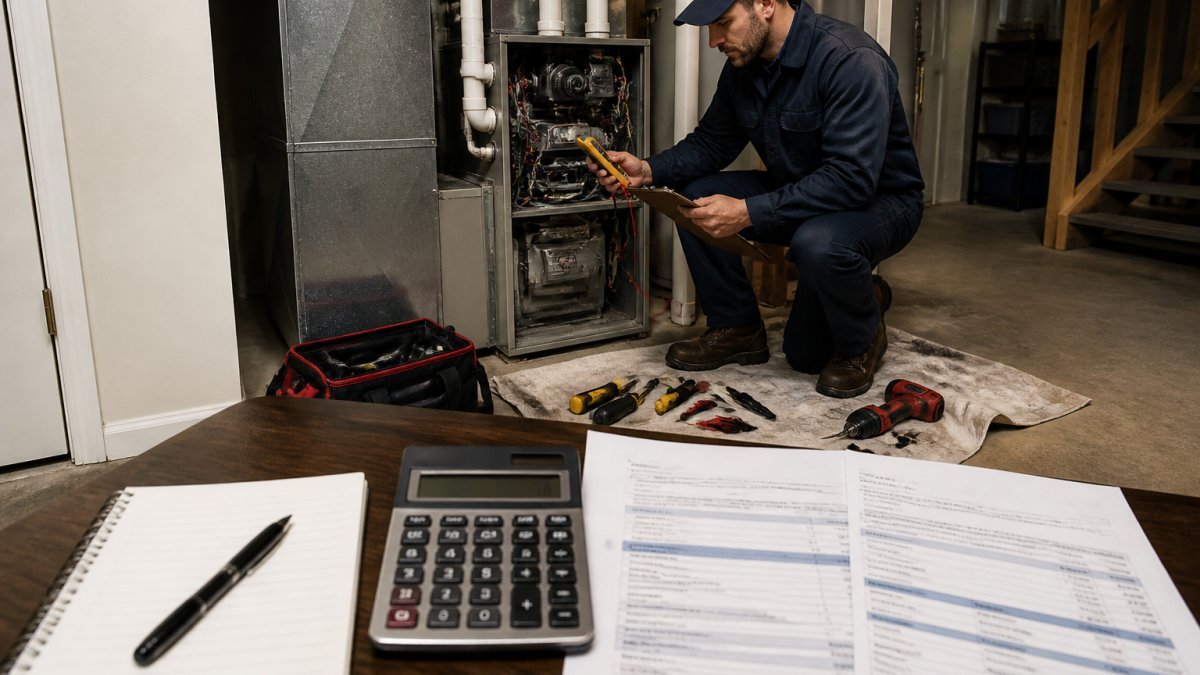
Repair bills typically combine a diagnostic fee, labor billed hourly or as a flat-rate price, and parts. Ask for each line separately.
A flat-rate quote folds diagnostic time, labor, and parts into one number, so it cannot be compared line by line to an hourly quote.
AC Repair Cost: What Cooling Fixes Run
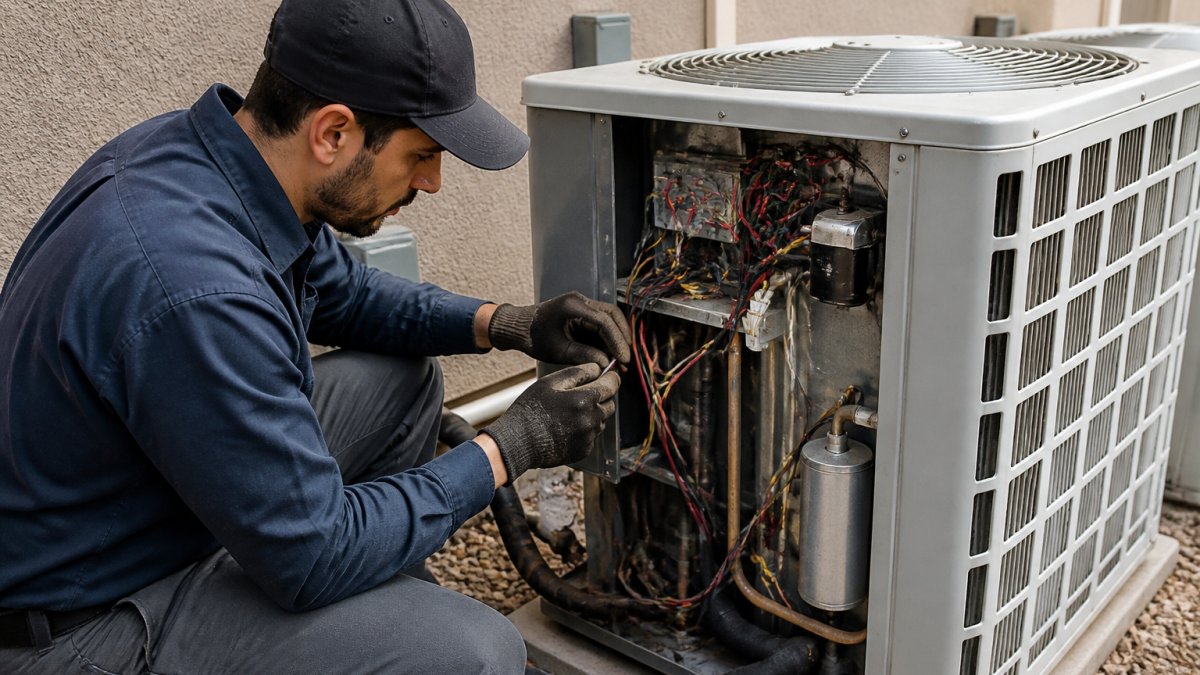
AC repair cost lands between $300 and $600 for common fixes, with most jobs falling in the $150-$1,500 band, per Home Rangers' 2026 AC repair analysis. The component that failed matters more than the system's brand, and the fastest way to sanity-check a quote is to know which band your symptom falls into.
| Cooling Problem | Typical Total Cost | Parts Share | Labor Share |
|---|---|---|---|
| Capacitor or contactor replacement | $150-$350 | $20-$60 | $100-$250 |
| Clogged condensate drain line | $150-$300 | $0-$30 | $120-$250 |
| Thermostat replacement (standard) | $150-$400 | $50-$200 | $100-$200 |
| Blower or fan motor replacement | $300-$700 | $150-$400 | $150-$300 |
| Evaporator or condenser coil cleaning | $300-$600 | $0-$50 | $250-$500 |
| Refrigerant leak detection and recharge | $400-$1,200 | $100-$600 | $250-$500 |
| Compressor replacement | $1,200-$2,800 | $700-$1,800 | $400-$900 |
Three patterns matter more than the exact numbers:
- Capacitors and contactors are often among the lower-cost fixes and a common no-cool call. They tend to fail suddenly and are often a short job.
- Motor and blower failures are where flat-rate pricing can hide the most. Ask whether the motor is OEM or aftermarket, since the choice affects both price and warranty.
- Compressor replacement is often where repair-versus-replace decisions get made, especially on older systems.
Refrigerant leaks deserve a specific warning. A technician who "tops off" refrigerant without locating the leak may be setting up a repeat visit, because refrigerant does not get consumed in a sealed system. A proper refrigerant recharge follows a leak diagnosis. A "recharge only" quote can look cheap until the leak returns.
If you want to see how a real repair quote is built, review our HVAC repair service and what a visit includes.
Furnace Repair Cost: What Heating Fixes Run
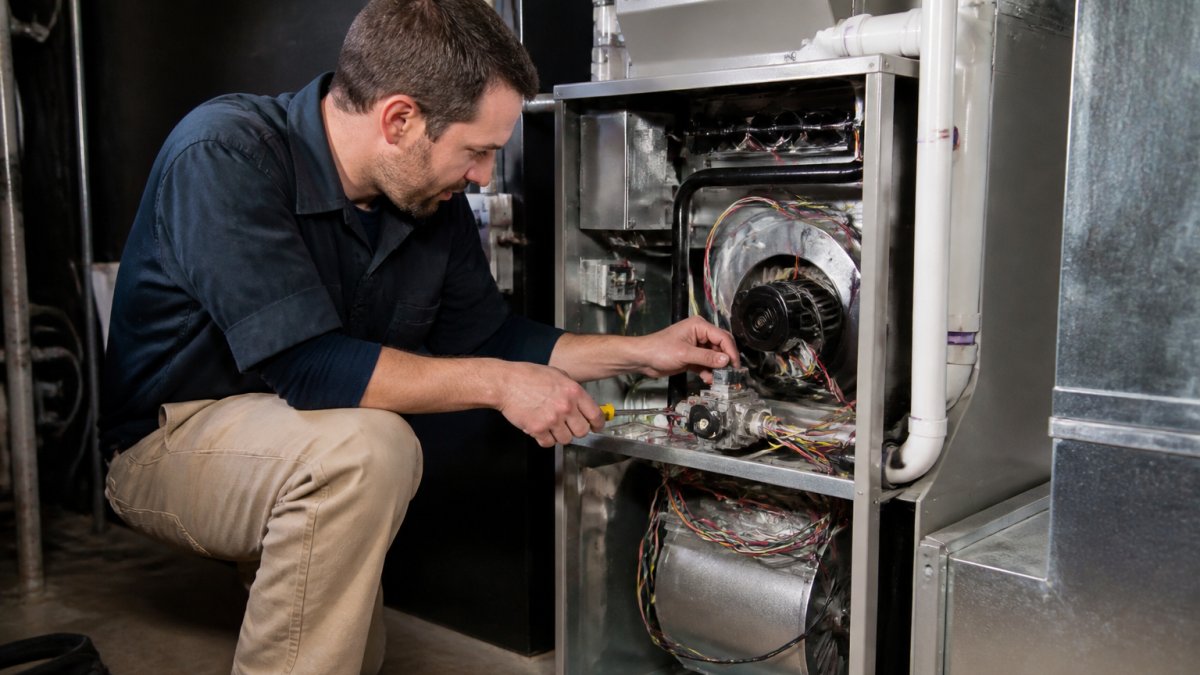
Furnace repair cost follows a similar pattern to cooling: minor electrical fixes are generally less expensive, and heat exchanger failures are not. Ignitors, flame sensors, and control boards are common repairs. A cracked heat exchanger is a safety issue.
Heating repairs can carry seasonal and after-hours surcharges, so timing can affect the price.
| Heating Problem | Typical Total Cost | Parts Share | Labor Share |
|---|---|---|---|
| Flame sensor cleaning or replacement | $100-$250 | $10-$60 | $90-$200 |
| Hot surface ignitor replacement | $150-$350 | $30-$100 | $120-$250 |
| Inducer or draft motor replacement | $300-$700 | $150-$400 | $150-$300 |
| Control board replacement | $400-$800 | $200-$500 | $200-$350 |
| Gas valve replacement | $400-$900 | $200-$500 | $200-$400 |
| Blower motor replacement | $300-$700 | $150-$400 | $150-$300 |
| Heat exchanger replacement | $1,200-$2,800 | $600-$1,800 | $500-$1,000 |
Four things drive the final heating bill more than the brand on the door:
- Safety components can take longer to diagnose. A heat exchanger inspection typically involves a combustion analysis and a visual check of the exchanger, not just a multimeter reading.
- Ignitors and flame sensors are often low-cost fixes and a common no-heat call. They tend to fail suddenly.
- Control boards and gas valves are where flat-rate pricing can hide the most. Ask whether the board is OEM or refurbished, since the choice affects both price and warranty.
- Heat exchanger failures are often the repair-versus-replace trigger, especially on older furnaces. A cracked exchanger on a gas furnace is a carbon monoxide risk that should not be deferred.
If your heat is out now, contact T. Gomes Heating & Cooling to schedule service.
Why HVAC Repair Pricing Varies So Much
Published repair price ranges vary widely across sources, and most do not publish a shared methodology, so the differences cannot be reconciled.
Four factors explain most of the real-world variation:
- System type and age: an older central HVAC system uses parts that cost more and take longer to source
- Component: a capacitor is not a compressor
- Region: labor rates differ by market, and local pricing reflects local overhead
- Timing: emergency, weekend, and seasonal calls carry surcharges
Treat any single national average as a starting point rather than a quote.
HVAC Repair vs. Replacement: Making the Call
HVAC repair versus replacement often comes down to two factors: system age and repair cost as a share of replacement cost. A common industry rule of thumb is that replacement may make more sense when a repair costs a large share of a new system and the equipment is well past its typical service life.
Use this framework:
- Under 10 years old, repair under 30% of replacement cost: repair
- 10-15 years old, repair 30-50% of replacement cost: repair, but start budgeting
- Over 15 years old, or repair above 50%: replace
- Compressor or heat exchanger failure on an aging system: replace
Replacement cost is a separate figure entirely. For current pricing on a system installation, contact T. Gomes Heating & Cooling for a quote.
How to Read an Estimate and Spot a Fair Price
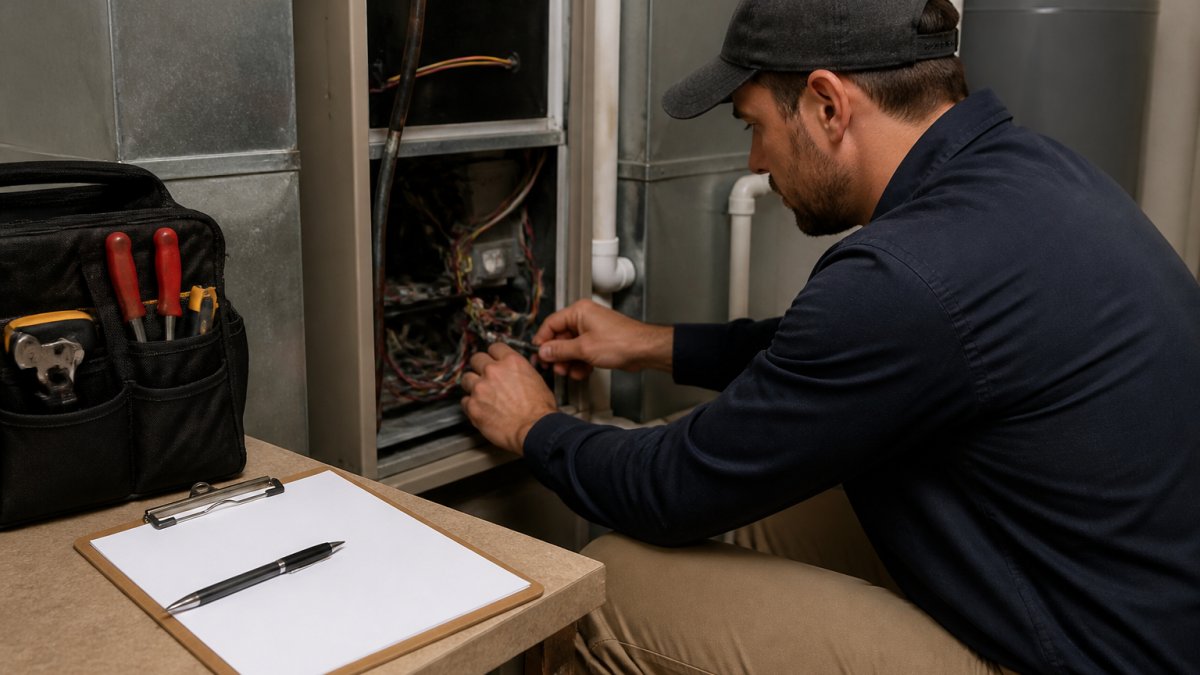
A fair HVAC repair estimate states the failed component, the part number, the labor rate or flat-rate price, the diagnostic fee, and the warranty on the repair. An estimate missing any of those five is not an estimate, it is a guess with a total at the bottom.
Check these before you sign:
- Failed component named, not just "system issue"
- Diagnostic fee stated separately from the repair
- Parts and labor broken out or flat-rate price justified
- Warranty term on parts and on labor, in writing
- No pressure to approve a replacement on the first visit
Ask directly whether a maintenance plan reduces future repair costs. Regular tune-ups can catch failing components before they become no-heat or no-cool calls.
Book a Repair Visit With T. Gomes Heating & Cooling
Pricing transparency only helps if the contractor quoting you is straight about what failed. T. Gomes Heating & Cooling has been operating since 2013 as a licensed and insured team, with a focus on integrity, fairness, and personal responsibility.
Customers describe the difference plainly. Sherry S. says, "Tony, the owner, is the best! Jason, the technician, is the best! I refer this company to everyone I know." Sara S. notes the team was "extremely fast, friendly, and effective."
You get full-spectrum repair and installation services, competitive pricing, and a customer-centered approach. Contact T. Gomes Heating & Cooling to schedule a visit.
Frequently Asked Questions
How much does an average HVAC repair cost in 2026?
Published 2026 guides vary widely on typical repair pricing. For a quote on your specific repair, contact T. Gomes Heating & Cooling. The spread is wide because a capacitor swap and a compressor replacement are both called repairs. Ask for an itemized estimate so you can compare the job to those ranges rather than to a single headline number.
How much does HVAC labor cost per hour?
Labor rates vary by market and by residential or commercial work. Ask about any service call or diagnostic fee and whether it is credited toward the repair.
Is it cheaper to repair or replace an HVAC system?
A repair is usually cheaper in the short term, but the math shifts as the system ages. Major failures such as a compressor or heat exchanger can be costly and can approach a meaningful share of replacement cost. A common rule is to weigh the repair price against system age and efficiency: a single expensive fix on an old, inefficient unit often favors replacement, while a minor repair on a mid-life system favors fixing it.
How can I tell whether an HVAC repair estimate is fair?
Ask for a written estimate that separates the diagnostic fee, labor hours and rate, and parts with part numbers. Compare the labor rate and any service call fee against other written quotes. A fair estimate explains what failed and why, not just a total. Consider a second quote for larger repairs, and ask whether the diagnostic fee is credited if you approve the repair.
Heating and cooling failures do not wait for a convenient moment, and the price uncertainty makes them worse. T. Gomes Heating & Cooling gives you a clear diagnosis, a quote tied to the failed part, and a licensed, insured crew that has been doing this work since 2013. Get started with T. Gomes Heating & Cooling and book a repair visit with a team that quotes the fix, not the fear.