 ultimate-guide
How to Improve Indoor Air Quality at Home
Last Updated: October 28, 2026
Quick Summary
To improve indoor air quality, ventilate daily with fresh air, keep indoor humidity between 30% and 50%, and change your HVAC filter every 1 to 3 months. Add a true HEPA purifier sized to the room and clean with HEPA vacuums and non-toxic products to cut dust and chemical exposure.
- The American Lung Association recommends opening windows for at least 10 minutes daily, even in winter.
- Run bathroom exhaust fans during showers and for 20 to 30 minutes afterward to remove mold-feeding humidity.
- Choose a purifier CADR equal to at least two-thirds of the room's square footage, assuming an 8-foot ceiling.
- True HEPA filters capture 99.97% of particles at 0.3 microns, but they do not capture gases or odors.
- Avoid ozone-generating ionizers entirely, since ozone is a lung irritant the EPA advises against.
Table of Contents
- Why Indoor Air Quality Matters More Than You Think
- Signs of Poor Indoor Air Quality You Should Not Ignore
- Step 1: Ventilate With Fresh Air Every Day
- Step 2: Control Humidity Before Mold Takes Hold
- Step 3: How Often to Change HVAC Filters for Cleaner Air
- Step 4: Choose the Best Air Purifiers for Home Use
- Step 5: Clean Smarter to Cut Dust and Chemical Exposure
- Book an HVAC Air Quality Assessment With T. Gomes
- Frequently Asked Questions
Why Indoor Air Quality Matters More Than You Think
Most homeowners obsess over outdoor pollution while ignoring the air inside their own walls. According to GPS Air's 2026 Building Health Data report, 66% of people say better ventilation, airflow, or temperature control would reassure them their environment is actively managed.
Below, we'll show you how to improve indoor air quality with practical steps, from ventilation to filtration. Indoor air quality involves several pollutants with different fixes.
The Most Common Indoor Air Pollutants and Where They Come From
Indoor air pollution comes from sources you'd never suspect. Cooking emissions, candles, and gas stoves release fine particles and nitrogen compounds. Carpets, rugs, and upholstery trap dust, pet dander, and allergens. Household chemicals, cleaning products, and fragrances add volatile organic compounds to the mix. Then there's mold, which thrives wherever humidity climbs. Radon and carbon monoxide are the silent threats, and neither has a smell. Harvard T.H. Chan School of Public Health experts emphasize HEPA filtration for particulate removal, which tells you how much of this load is physical particles you can capture rather than just dilute.
Signs of Poor Indoor Air Quality You Should Not Ignore
Your body usually flags the problem before any monitor does. Watch for these signs of poor indoor air quality:
- Worsening allergies or asthma symptoms indoors
- Persistent headaches, fatigue, or dizziness
- Dry, itchy eyes and throat
- Musty odors that return after cleaning
- Condensation on windows or damp patches on walls
- Dust settling visibly within a day of cleaning
If symptoms ease when you leave the house and return when you come back, that pattern is a strong clue. See a doctor for persistent symptoms; the guidance here is about your home, not a diagnosis.
Step 1: Ventilate With Fresh Air Every Day
The cheapest fix is the one people skip, but "open a window" is only half the advice. Ventilation works by diluting indoor pollutants with outdoor air and by flushing moisture and combustion byproducts out of the house. Whether that trade is a net win depends entirely on what is happening outside your window at that moment.
When opening windows helps
- Cooking. Run the range hood every time you use the stove, and crack a window if the hood is recirculating rather than venting outdoors. The American Lung Association recommends opening windows for at least 10 minutes daily, even in winter, to improve indoor air quality.
- Bathrooms and showers. Run the exhaust fan during and for 20 to 30 minutes after a shower. Humidity is the fuel for mold, and a fan that vents outdoors removes it at the source.
- After cleaning, painting, or new furniture. Off-gassing from paints, adhesives, and pressed-wood products peaks in the first days and weeks. Cross-ventilation, open windows on opposite sides of the home, moves volatile organic compounds out faster than a single open window.
- Mild, low-pollen days. This is the default good-ventilation window in most of the country.
When opening windows hurts
This is the part most guides skip, and it matters more every year:
- Wildfire smoke. When outdoor air quality is unhealthy, keep windows closed and rely on a HEPA purifier or a high-MERV HVAC filter instead. Check the Air Quality Index (AQI) at AirNow.gov before you open up.
- High pollen days. If you or anyone in the home has seasonal allergies, ventilate in the late afternoon or evening when pollen counts typically drop, and keep bedroom windows closed overnight.
- Ozone alerts. Ground-level ozone peaks on hot, sunny afternoons in summer. Ventilate in the morning instead.
- Extreme heat or cold. A cracked window in a 15°F cold snap or a 100°F heat wave wastes energy and can stress your HVAC system. Use short bursts rather than all-day openings.
Ventilation when you can't open windows
Renters, upper-floor apartments, and homes in smoke- or pollen-heavy regions still need fresh air. Options include:
- A heat-recovery or energy-recovery ventilator (HRV/ERV). These bring in filtered outdoor air while recovering heat or moisture from the exhaust stream. They are the gold standard for tight, well-sealed homes.
- A window fan set to exhaust. It pulls stale air out and draws fresh air in through other openings, which is useful when cross-breezes fail.
- A portable air purifier with a HEPA filter in the room you use most, as a stopgap when outdoor air is genuinely bad.
Run bathroom exhaust fans during showers and range hoods while cooking; the Journal of Allergy and Clinical Immunology notes growing momentum behind building codes that require range hoods to vent outdoors. In practice, ten minutes of real fresh air beats an hour of recirculated air through a dirty filter, but only on days when the outdoor air is actually cleaner than the indoor air.
Step 2: Control Humidity Before Mold Takes Hold
Mold needs moisture, so humidity control is mold prevention. The EPA recommends keeping indoor humidity below 60%, with an ideal range of 30% to 50% (the EPA). Buy an inexpensive hygrometer and check each floor of your home. Fix leaks promptly, vent dryers outdoors, and run the bathroom fan until mirrors clear. In humid months, a dehumidifier in basements and crawl spaces makes a measurable difference. If you spot extensive mold growth or persistent dampness, that's a job for a professional assessment, not a bottle of spray.
Step 3: How Often to Change HVAC Filters for Cleaner Air
Change your HVAC filter every 1 to 3 months, or more often with pets, allergies, or heavy dust. That single habit is the highest-return maintenance task in your home. A clogged filter chokes airflow, strains the blower, and recirculates the very particles you want captured. For professional HVAC maintenance, our team can handle the seasonal tune-up.
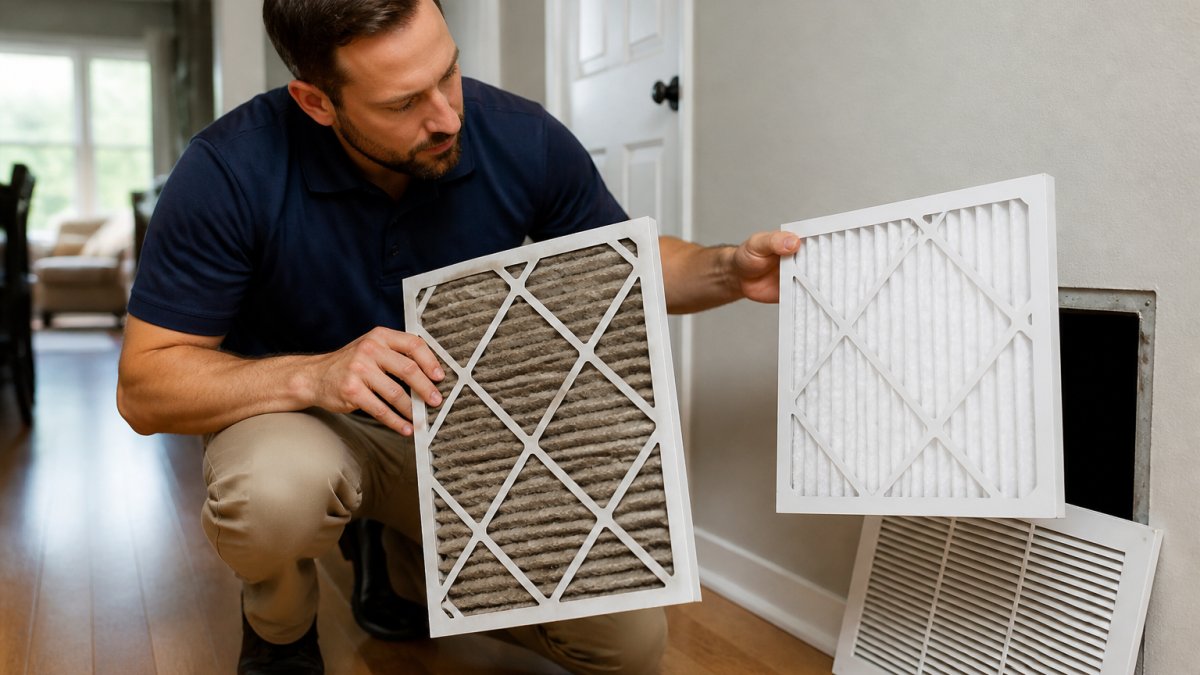
Filter changes are the highest-return maintenance task, and the schedule depends on your home.
| Item | Value | Note |
|---|---|---|
| Filter change interval | Every 1 to 3 months | More often with pets, allergies, or heavy dust |
| Filter check | Monthly | Hold up to light; replace if you can't see through it |
| Filter size | Size printed on the filter frame | Match MERV rating to system specifications |
Step 4: Choose the Best Air Purifiers for Home Use
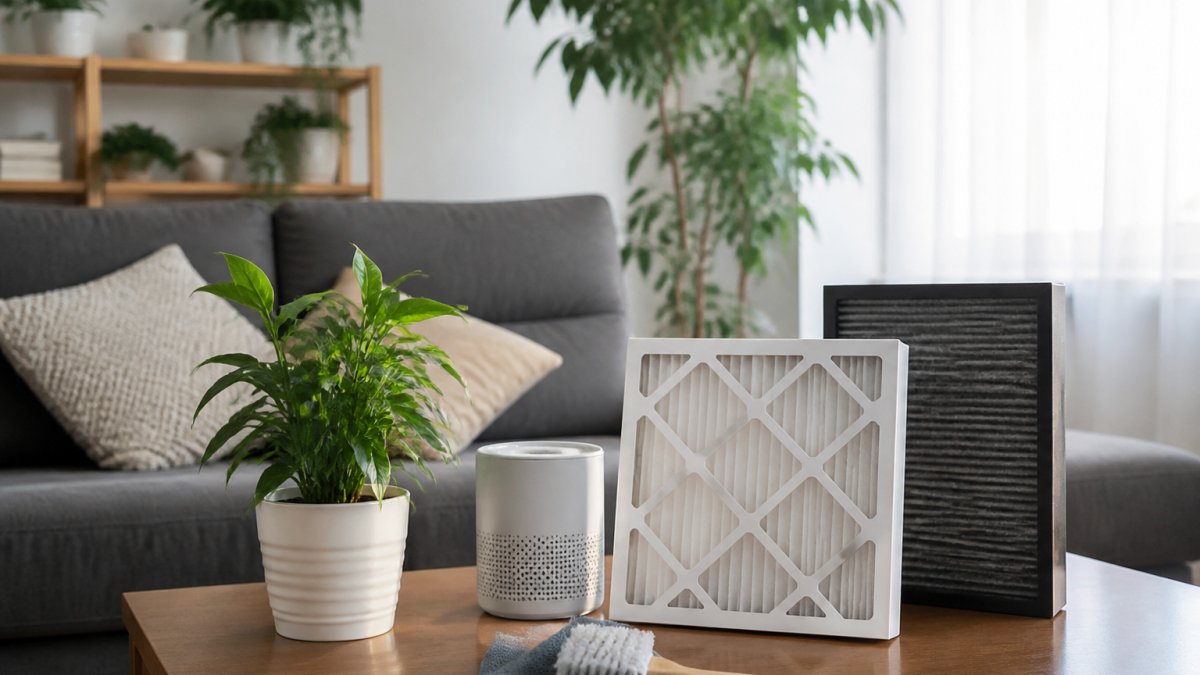
The best air purifiers for home use pair a true HEPA filter with a clean-air delivery rate (CADR) sized to the room, but "sized to the room" is where most buyers guess wrong. Here is the math and the tradeoffs.
The sizing rule that actually works
CADR is measured in cubic feet per minute (CFM) and tells you how much filtered air the unit moves. A common rule of thumb is to choose a CADR equal to at least two-thirds of the room's square footage, assuming an 8-foot ceiling. For a 300-square-foot bedroom, that means a CADR of roughly 200 CFM.
Also check the noise rating. A unit that is too loud to run at night will sit off, which defeats the purpose. Look for a sleep mode in the low-20s decibels.
What a purifier can and cannot remove
- Particles (dust, pollen, pet dander, smoke). A true HEPA filter captures 99.97% of particles at 0.3 microns (the EPA). This is the purifier's strong suit.
- Volatile organic compounds (VOCs) and odors. HEPA does not capture gases. You need an activated carbon filter, and carbon filters vary widely in how much they hold. Replace them on the manufacturer's schedule; a saturated carbon filter stops working and can release odors back into the room.
- Carbon monoxide and radon. No portable purifier removes these. CO requires source control and detection; radon requires a sub-slab depressurization system installed by a certified professional.
- Mold. A purifier can capture airborne spores, but it does not fix the moisture problem that produces them. Fix the leak first.
How to read a sensor (and when to ignore it)
Many purifiers now include a built-in particulate sensor and an auto mode. These sensors are useful for spotting trends, a spike when you sear a steak, a drop after the unit ramps up, but they are not lab instruments. Low-cost optical sensors can be fooled by humidity, aerosols, and even cooking steam, and most do not measure VOCs, carbon monoxide, or radon at all. If you want a broader picture, a standalone indoor air quality monitor that reports particulate matter (PM2.5), VOCs, and CO2 gives you more to work with. Treat the numbers as directional, not diagnostic.
Placement and maintenance
Place units in the rooms where you sleep and spend evenings, and keep doors closed for efficiency. Keep the unit a few feet from walls and furniture so it can pull air in. Vacuum the pre-filter monthly and replace the HEPA filter on the manufacturer's schedule, typically every 6 to 12 months in normal use, more often with pets or heavy smoke. A purifier is a supplement, not a substitute for ventilation and filtration. Explore our residential HVAC solutions.
Step 5: Clean Smarter to Cut Dust and Chemical Exposure
Cleaning can either reduce pollutants or add them. Vacuum carpets, rugs, and upholstery weekly with a HEPA-equipped vacuum. Wet dust surfaces with a damp cloth instead of dry dusting, which just launches particles back into the air. Choose non-toxic cleaners and skip synthetic fragrances and aerosol sprays; they add volatile organic compounds with no cleaning benefit. Wash bedding in hot water, and keep entry mats at every door to stop dust at the threshold. A common mistake is masking odors with air fresheners when the real fix is source control and better air circulation.
Book an HVAC Air Quality Assessment With T. Gomes
Improving indoor air quality in your home comes down to consistent habits: ventilate daily, control humidity, replace filters on schedule, filter the air, and clean with intention. Our licensed and insured team has served homeowners and businesses since 2013. Review our full range of services, then contact us.
Frequently Asked Questions
What are the most common indoor air pollutants?
The usual suspects are particulate matter from dust, pollen and smoke; volatile organic compounds (VOCs) off-gassing from paints, furniture and cleaning products; mold spores in damp areas; carbon monoxide from fuel-burning appliances; and radon seeping up from the soil. Cooking emissions and pet dander add to the load. Source control, ventilation and filtration tackle all of them, but each pollutant responds differently, which is why a single air purifier rarely solves everything.
How often should HVAC filters be changed to improve air quality?
Follow the filter manufacturer's guidance for replacement. Check the filter regularly and replace it as directed.
Does vacuuming improve air quality?
Vacuuming and wet dusting are cleaning steps that can remove dust from surfaces.
What naturally kills bacteria in the air?
This article does not establish a reliable way to kill airborne bacteria in a home.
At what AQI should I stay indoors?
Check the daily Air Quality Index forecast for current air-quality information.
How do I keep indoor air clean during winter when windows stay shut?
For winter indoor-air guidance, consult current recommendations from relevant public-health authorities and your HVAC system's manufacturer.
Your HVAC system is the engine of your home's air quality, and small maintenance gaps compound into big problems. T. Gomes Heating & Cooling brings licensed, insured expertise, honest recommendations, and prompt service to every visit. Get started with T. Gomes Heating & Cooling and schedule an air quality assessment today.