 how-to
How to Tell If Your Furnace Needs Repair
Last Updated: October 31, 2026
Quick Summary
You can tell your furnace needs furnace repair when it runs loudly, heats unevenly, or drives up your bills, and most homeowners pay around $352 for a repair. Shut the system down and call a pro immediately for a gas smell, a carbon monoxide alarm, or a flame that is not steady blue.
- A gas furnace usually lasts 15 to 20 years with regular maintenance, and electric furnaces often run longer.
- Three repairs in two heating seasons, or the same part failing twice, points to a deeper problem.
- Replace the air filter every 1 to 3 months and schedule a professional tune-up before the heating season.
- If a single repair approaches one-third to one-half the cost of a new system, replacement deserves serious consideration.
- A cracked heat exchanger is the clearest replace signal because patching rarely holds.
Table of Contents
- Warning Signs Your Furnace Needs Repair
- Furnace Blowing Cold Air: What It Means
- Furnace Making Unusual Noises: Banging, Rattling, and Squealing
- Performance and Efficiency Problems: Rising Bills and Uneven Heating
- Emergency Warning Signs: Discolored Flame, Gas Smells, and Carbon Monoxide
- Furnace Repair or Replacement: How to Decide
- Your Furnace Maintenance Checklist for Fewer Repairs
- Booking a Furnace Repair Visit with T. Gomes Heating & Cooling
- Frequently Asked Questions
Warning Signs Your Furnace Needs Repair
Most homeowners wait too long to call for help.
This guide from T. Gomes Heating & Cooling walks through the warning signs in order of urgency. Some you can check yourself in minutes.
The stakes are real. According to Thumbtack's furnace repair cost data, most homeowners pay around $352 for a furnace repair, with a typical range of $170 to $735.
Furnace Age and Expected Lifespan
A gas furnace usually lasts 15 to 20 years with regular maintenance. Electric furnaces often run a bit longer.
Age alone doesn't mean replace it. But an older furnace plus a rising repair bill is a signal worth heeding. Parts get harder to source, and efficiency drops as components wear.
Check the data plate inside the unit or the service record from the last owner.
Frequent or Increasingly Costly Repairs
One repair every few years is normal. Three in two seasons is not. When repairs start stacking up, the furnace is telling you something.
A practical test: add up repair spending over the last two years. If that total is climbing toward the cost of a new system, replacement is worth serious consideration.
Repeated failures of the same part are a red flag too. A blower motor that dies twice points to an underlying airflow or electrical problem, not bad luck.
Furnace Blowing Cold Air: What It Means
A furnace blowing cold air means the system is running but not heating. The cause is usually simple: a thermostat set to "fan," a clogged air filter, a pilot light out, or a gas supply issue. Start with the easy checks before you call anyone.
Thermostat and Airflow Checks to Try First
Before you assume the worst, run through these quick checks. Most take under five minutes.
- Check the thermostat mode. Make sure it's set to "Heat," not "Fan" or "Cool." Set the temperature a few degrees above room temp.
- Replace the air filter. A clogged filter chokes airflow and can trip the system's safety switch. Hold it up to the light; if you can't see through it, swap it.
- Check the breaker. A tripped breaker cuts power to the blower. Reset it once.
- Confirm the gas valve is open. The supply valve near the furnace should run parallel to the pipe.
- Check the pilot light or igniter. A steady blue flame means the pilot is fine. No flame means a gas or ignition problem.
If the furnace still blows cold after these checks, stop and call a technician. A gas-related issue is not a DIY fix.
Furnace Making Unusual Noises: Banging, Rattling, and Squealing
Noises are your furnace's way of asking for help. Each sound points to a different cause, and some are more urgent than others.
- Banging or booming: Delayed ignition. Gas builds up before it lights, which is both loud and unsafe.
- Rattling: Loose panels, screws, or ductwork. Often a cheap fix if caught early.
- Squealing: A worn blower belt or a failing motor bearing. It gets worse fast.
A banging furnace is the one to take seriously. Delayed ignition can stress the heat exchanger and, in rare cases, cause a small explosion inside the unit.
Performance and Efficiency Problems: Rising Bills and Uneven Heating
Your energy bill is a diagnostic tool. A furnace that costs more to run this winter than last is working harder than it should. That extra effort shows up on your statement before it shows up as a breakdown.
Common causes include a dirty filter, a failing blower, leaky ducts, or a furnace past its efficiency prime. A tune-up often finds the culprit.
Reduced Heating Performance and Cold Rooms
Some rooms warm up fast. Others stay cold no matter what you do. That pattern points to an airflow or duct problem more often than a dead furnace.
Try these steps:
- Check vents and returns. Furniture, rugs, or closed dampers block airflow.
- Balance the dampers. Open dampers in cold rooms and partially close them in warm ones.
- Inspect ductwork. Leaks in unconditioned spaces waste heat before it reaches the room.
If cold rooms persist after these checks, the issue may be duct design or a failing component. That's a job for a technician with airflow testing tools.
Emergency Warning Signs: Discolored Flame, Gas Smells, and Carbon Monoxide
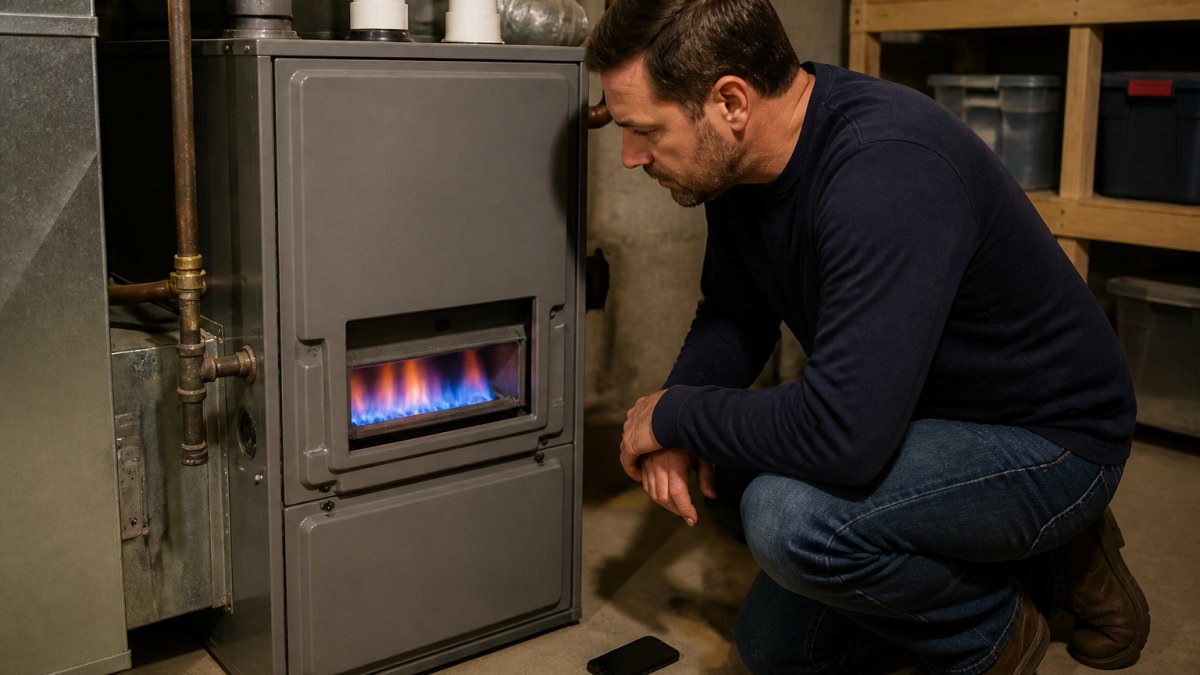
Some furnace symptoms are not maintenance items. They are life-safety events. The three that matter most are a gas odor, a carbon monoxide alarm, and a burner flame that is not steady blue.
If You Smell Gas
Natural gas and propane are given an odorant so leaks are noticeable. If you smell gas near the furnace or anywhere in the home:
- Do not flip light switches, use a phone inside, or start a vehicle in an attached garage.
- Do not try to relight the pilot or reset the furnace.
- Leave the building immediately and take everyone with you.
- From outside, call your gas utility's emergency line or 911. Many utilities ask you to call before re-entering.
- Do not re-enter until the utility or a licensed technician clears the property.
A gas smell is never a wait-and-see problem. Even a faint, intermittent odor can indicate a joint, valve, or heat exchanger issue that needs professional leak detection.
If a Carbon Monoxide Alarm Sounds
Carbon monoxide (CO) is odorless and invisible (the CDC). A CO alarm is designed to sound before levels become immediately dangerous, so act right away:
- Get everyone, including pets, outside to fresh air.
- Call 911 or the fire department from outside.
- Do not re-enter until emergency responders say it is safe.
Early CO exposure can cause headaches, dizziness, nausea, and fatigue that ease when you leave the home. If those symptoms appear alongside a CO alarm or a yellow flame, treat it as confirmed exposure and seek medical advice.
A Flame That Is Not Blue
A healthy gas furnace burns a steady blue flame with a crisp inner cone. Yellow, orange, or flickering flames can mean incomplete combustion, dirty burners, or a venting problem that produces CO. Shut the furnace off at the thermostat or service switch and call a technician, don't keep running it to "see if it clears up."
Safe Checks vs. Stop-Now Checks
It helps to know which checks are reasonable for a homeowner and which are not.
| Situation | Safe homeowner action | Stop and call a pro |
|---|---|---|
| Thermostat set wrong | Reset mode and setpoint | , |
| Clogged filter | Replace filter | , |
| Tripped breaker | Reset once | Repeated trips |
| Gas odor | Leave the building | Re-entering or relighting |
| CO alarm | Evacuate and call 911 | Running the furnace again |
| Yellow or orange flame | Shut off at thermostat | Diagnosing combustion |
| Screeching or banging | Shut off at thermostat | Opening the cabinet |
If you are unsure whether a symptom is safe to investigate, err on the side of shutting the system down and calling for service. For a gas or CO concern, contact our team right away.
Furnace Repair or Replacement: How to Decide
The repair-or-replace decision is rarely about age alone. A 16-year-old furnace with a clean service history and a $180 repair may still be the right call; a 9-year-old furnace with a cracked heat exchanger is not. Weigh five factors: age, repair cost, repair frequency, efficiency, and warranty status.
The Five Factors That Matter
- Age versus expected life. A gas furnace typically lasts 15 to 20 years with regular maintenance; electric furnaces often run somewhat longer. Past that window, parts availability and efficiency decline.
- Repair cost versus replacement cost. If a single repair approaches one-third to one-half the cost of a new system, replacement deserves serious consideration. Get the repair estimate in writing and compare it to a replacement quote.
- Repair frequency. One repair every few years is normal. Three repairs in two heating seasons, or the same part failing twice, points to a deeper problem.
- Efficiency. Older furnaces may run at lower annual fuel utilization efficiency (AFUE) than modern units. A high-efficiency replacement can reduce operating costs, but payback depends on local energy prices and how long you plan to stay.
- Warranty status. If the furnace is still under a parts warranty, a repair may be much cheaper than it looks. If the warranty has expired and the part is expensive, the math shifts toward replacement.
A Practical Decision Table
| Situation | Typical recommendation |
|---|---|
| Under 10 years old, first repair, part under warranty | Repair |
| 10-15 years old, repair under one-third of replacement cost | Repair, then maintain |
| Over 15 years old, second major repair | Lean toward replacement |
| Any age, cracked heat exchanger | Replace |
| Repairs every season, rising bills | Replace |
| Efficiency far below modern standards and you plan to stay | Consider replacement |
A cracked heat exchanger is the clearest replace signal because it is a safety issue and patching rarely holds. For systems nearing end of life, look at installation options before committing to another repair.
What to Ask Before You Decide
- What is the exact diagnosis, and what part failed?
- Is the part under warranty, and does the warranty cover labor?
- What is the expected remaining life of the system?
If you are weighing a repair against replacement, book a furnace repair visit and ask for a straight comparison.
Your Furnace Maintenance Checklist for Fewer Repairs
Most furnace failures start as small issues that a yearly tune-up would have caught. A little upkeep now saves a big bill later.
Run through this checklist each fall:
- Replace the air filter every 1-3 months
- Clear vents, returns, and the area around the furnace
- Test the thermostat and replace batteries
A professional maintenance check can go deeper than homeowner checks. See our maintenance service to get on a yearly schedule.
Booking a Furnace Repair Visit with T. Gomes Heating & Cooling
Here's what to expect when you book.
T. Gomes Heating & Cooling has been operating since 2013 as a licensed and insured team.
Customer Sherry S. shared: "Tony, the owner, is the best! Jason, the technician, is the best! I refer this company to everyone I know."
When your furnace is acting up, don't wait for it to fail on the coldest night of the year. Book a furnace repair visit and get a straight answer on what's wrong and what it takes to fix it.
Frequently Asked Questions
What are the most common signs that a furnace needs repair?
The most common signs include unusual noises like banging or squealing, the furnace blowing cold air, uneven heating or cold rooms, rising energy bills, frequent cycling, and a yellow or orange burner flame instead of a steady blue one. Frequent repairs and a furnace age past 15 years also point to trouble. If you notice any of these, schedule a furnace repair diagnostic before the problem worsens and leaves you without heat.
How often should a furnace be inspected or maintained?
Schedule a professional furnace maintenance check once a year, ideally in early fall before heating season. Between visits, follow a simple furnace maintenance checklist: replace the air filter every one to three months, keep vents and returns clear, and check the thermostat batteries. Annual service can help catch small issues before they become larger repair needs.
When should I repair a furnace instead of replacing it?
Repair usually makes sense when the furnace is under 15 years old, the problem is isolated, and the repair cost is a small share of replacement. Consider furnace repair or replacement carefully if the unit is older, needs repeated repairs, or uses costly fuel. A technician can diagnose the issue and give you a straight estimate so you can decide without pressure.
Why is my furnace blowing cold air?
A furnace blowing cold air often points to a thermostat set to fan-only, a clogged air filter restricting airflow, a pilot or ignition problem, or a gas supply issue. Start by checking the thermostat mode and replacing a dirty filter. If the air stays cold, the cause may be a failed igniter or blower problem that needs a technician to diagnose before the heating system fails entirely.
A furnace that bangs, blows cold, or burns yellow is asking for attention. Catching the signs early keeps small fixes small and your family safe. T. Gomes Heating & Cooling brings licensed, insured technicians, honest estimates, and a repair-first mindset to every call. Get started with T. Gomes Heating & Cooling and get your heat back before the next cold snap.