 how-to
HVAC Service for Property Managers: 2026 Planning Guide
Last Updated: October 23, 2026
Quick Summary
HVAC service for property managers is the planned combination of preventive maintenance, emergency repair, and vendor coordination that keeps heating and cooling systems running across every unit in a rental portfolio. It is an operating discipline, not a one-off transaction, built on seasonal checklists, written service contracts, and tracked vendor performance.
- Run a preventive maintenance checklist in spring for cooling and fall for heating on every rental unit.
- Set a service cadence of typically two visits per year per system and budget from that cadence.
- Define emergency, urgent, and routine urgency tiers with separate written response commitments in the contract.
- Track response-time adherence, first-visit resolution, repeat-call rate, and documentation compliance quarterly.
- Stagger seasonal visits by building so the whole portfolio is not due in the same month.
Table of Contents
- Why HVAC Service for Property Managers Is a Portfolio Issue, Not a Repair Task
- The HVAC Preventive Maintenance Checklist Every Rental Property Needs
- Building a Property Management HVAC Maintenance Plan Across a Portfolio
- What an HVAC Service Contract for Commercial Properties Should Include
- HVAC Emergency Service for Property Managers: After-Hours and 24/7 Response
- Choosing an HVAC Service Provider: Vetting, Documentation, and Performance Tracking
- Budgeting, Tenant Coordination, and Total Cost of Ownership
- Frequently Asked Questions
Why HVAC Service for Property Managers Is a Portfolio Issue, Not a Repair Task
Most property managers treat a broken furnace as a single work order.
HVAC service for property managers is the planned combination of preventive maintenance, emergency repair, and vendor coordination that keeps heating and cooling systems running across every unit in a rental portfolio. It is not a one-off transaction.
At T.
The stakes are practical. A failed HVAC unit in a multifamily building triggers tenant complaints, possible habitability concerns, and emergency spending at premium rates.
Below, we break down the checklists, contracts, and workflows that turn HVAC from a recurring headache into a line item you can forecast.
The HVAC Preventive Maintenance Checklist Every Rental Property Needs
An HVAC preventive maintenance checklist is a seasonal inspection and service schedule that covers filters, refrigerant levels, electrical components, drainage, and controls before failures happen.
A workable checklist for a rental unit covers the following:
- Replace or clean air filters on a set interval, not when someone remembers
- Inspect and clear condensate drain lines to prevent water damage
- Check refrigerant charge and inspect for leaks
That last item matters more than most managers realize. Documentation is your defense when a tenant disputes a charge or when you need to prove you maintained the unit.
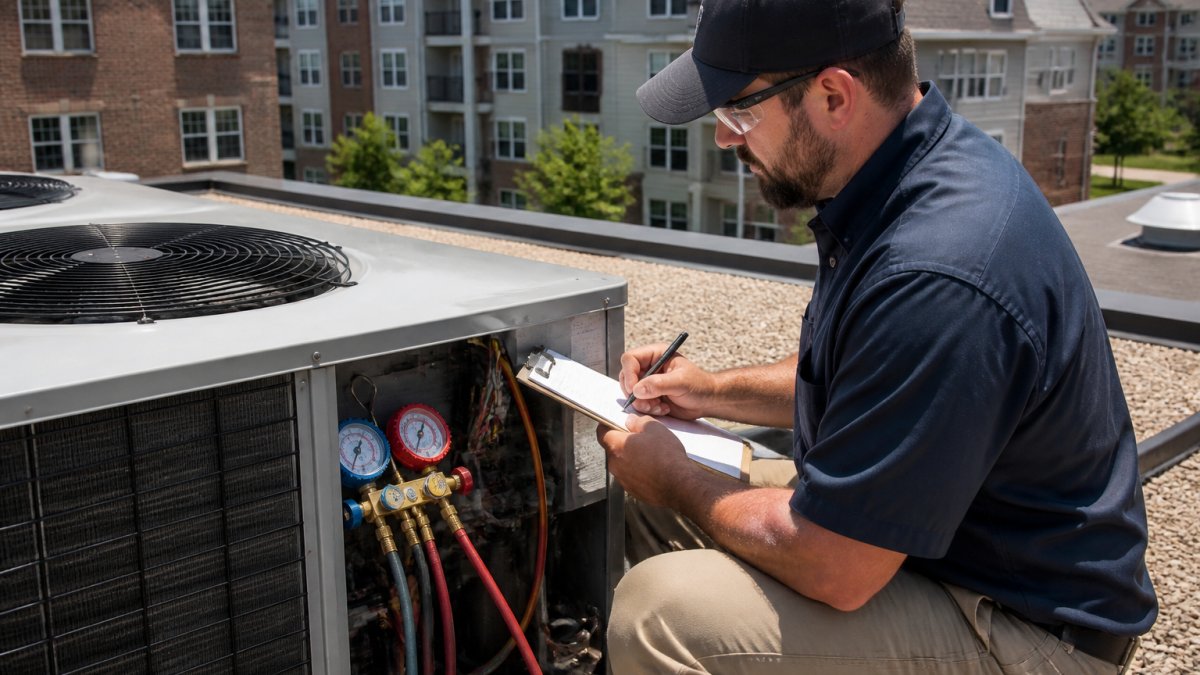
Seasonal Tasks: What Gets Checked and When
Spring service focuses on cooling: coil cleaning, refrigerant checks, and condensate management before the first heat wave. Fall service shifts to heating: burner inspection, heat exchanger checks, and ignition testing before the first cold snap.
A common mistake is scheduling both visits in the same month for the whole portfolio. Stagger them by building so your technician is not overloaded and your units are not all due at once.
Building a Property Management HVAC Maintenance Plan Across a Portfolio
A property management HVAC maintenance plan is a written schedule that assigns every unit in the portfolio a service cadence, a responsible vendor, and a budget line.
Here is how we would structure one:
- Inventory every unit and system, including age, fuel type, and model number
- Group units by building and by equipment age
- Set a service cadence, typically two visits per year per system
- Assign a primary vendor and a backup
- Build the annual budget from the cadence, not from last year's emergencies
- Track completion rates and open work orders monthly
The inventory step is where most plans stall. Managers inherit a portfolio with no reliable equipment records, so they skip the audit and jump straight to scheduling. That produces a plan built on guesses.
What an HVAC Service Contract for Commercial Properties Should Include
An HVAC service contract for commercial properties is a written agreement covering scheduled maintenance, priority repair response, and defined pricing terms for a portfolio. The contract should name what is covered, what is excluded, and how fast the provider responds. Most ranking pages stop at that definition. The useful version goes further: it converts vague promises into measurable service-level agreements you can hold a vendor to.
Look for these elements:
- Scope of scheduled visits and what each visit includes
- Parts and labor terms, including which repairs are covered
- Priority scheduling status for contract holders
Service-Level Agreements and Response-Time Expectations
A service-level agreement defines the response window the provider commits to.
A workable SLA separates urgency tiers so the same clock does not apply to a dead thermostat and a no-heat call in January. A common structure looks like this:
- Emergency (no heat or no cooling during extreme temperatures, gas smell, water leak from equipment): on-site arrival target measured in hours, with a live person answering the after-hours line.
- Urgent (system down but space is habitable, repeated tripping, partial failure in a multifamily building): next-business-day on-site arrival.
- Routine (maintenance, minor comfort complaints, filter and belt service): scheduled within an agreed window, typically within a set number of business days.
Define the clock start. Does response time begin when the work order is submitted, when the tenant calls, or when the provider acknowledges?
For after-hours coverage, confirm who answers the phone, whether dispatch is handled by the same technicians or a rotating crew, and how after-hours billing is calculated.
A contract with no written response window leaves you with no recourse when a tenant is without heat in January. Insist on a documented commitment, a defined clock start, and an escalation contact before you sign.
Vendor Performance Measurement
An SLA is only useful if you measure against it. Track these indicators per provider and review them quarterly:
- Response-time adherence: percentage of calls where on-site arrival met the tier target.
- First-visit resolution rate: share of calls closed without a return trip.
- Repeat-call rate: same unit, same issue within a defined window, such as 30 days.
A provider that meets the SLA but generates repeat calls is not saving you money. A provider that misses the SLA but resolves issues on the first visit is still a risk during emergencies. Measure both, and put the results in the same file as the contract so renewal decisions rest on evidence rather than impressions.
The contract should sort calls into urgency tiers, each with its own response commitment.
| Urgency tier | Examples | Response commitment |
|---|---|---|
| Emergency | No heat or cooling in extreme temperatures, gas smell, water leak | On-site arrival target measured in hours; live after-hours line |
| Urgent | System down but space habitable, repeated tripping, partial multifamily failure | Next-business-day on-site arrival |
| Routine | Maintenance, minor comfort complaints, filter and belt service | Scheduled within an agreed window, typically set business days |
HVAC Emergency Service for Property Managers: After-Hours and 24/7 Response
HVAC emergency service for property managers is after-hours and weekend coverage for system failures that threaten tenant safety or habitability.
When a furnace dies at 11 p.m., you do not want to be calling unfamiliar numbers.
What to confirm in advance:
- The after-hours phone number and who answers it
- Whether a live person or a call service responds
- Typical dispatch time for your area
Our team at T. Gomes Heating & Cooling keeps customer interests at the center of how we operate, which in practice means answering the phone and showing up when we say we will.
Choosing an HVAC Service Provider: Vetting, Documentation, and Performance Tracking
Choosing an HVAC service provider comes down to four checks: licensing and insurance, documented work, references you can actually verify, and a track record you can measure over time. Price matters, but reliability matters more in a portfolio.
Vet a provider on these points:
- Current license and proof of insurance
- Written estimates before work begins
- Service documentation after every visit
Then track performance. Log response times, first-visit fix rates, repeat visits for the same issue, and cost per unit per year.
Documentation also protects you on safety and compliance. Keep inspection records, repair invoices, and equipment logs in the unit file. If a tenant raises a habitability concern, that paper trail is your answer.
Budgeting, Tenant Coordination, and Total Cost of Ownership
Total cost of ownership for HVAC is the sum of service visits, repairs, energy use, and replacement timing across a system's life. Planned maintenance lowers that total by extending equipment lifespan and protecting system efficiency. That definition is easy to write and hard to act on, so here is how to turn it into a budget and a workflow.
Building the Maintenance Budget
Budgeting starts with the inventory you built earlier. From there, separate spending into three buckets:
- Scheduled maintenance: the predictable cost of two visits per system per year, priced from your contract rather than from last year's invoices.
- Repair reserve: a set-aside per unit per year for unscheduled failures. Managers who track this find the reserve is smaller when maintenance completion is high and larger when it slips.
- Capital replacement: a sinking fund for systems approaching the end of their service life, funded annually so a rooftop unit failure does not become an emergency capital request.
Forecast from the cadence, not from last year's emergencies. A budget built on emergency spending rewards reactive behavior; a budget built on scheduled visits makes the plan the default.
Repair Versus Replace
When a system fails, the decision is rarely about the repair price alone. Compare the repair cost against the remaining life of the equipment, the efficiency of the existing unit, and the likelihood of repeat failures. A common pattern is to repair while the equipment is within its expected service life and the repair is a small fraction of replacement cost, and to replace when repeated repairs, parts availability, or efficiency losses make the unit a recurring line item.
Tenant Coordination and Access Workflow
Access scheduling is where maintenance plans quietly fail. Give tenants clear notice, offer defined windows, and use a work order system so nothing gets lost in text threads. A repeatable workflow looks like this:
- Report: tenant or staff submits the issue through one channel, with unit number, system type, and a description of the symptom.
- Triage: manager assigns an urgency tier using the same emergency, urgent, and routine definitions used in the service contract.
- Access: manager offers defined arrival windows, documents notice, and records whether the tenant will be present or a key or lockbox will be used.
- Approve: manager sets a spending threshold; work above it requires written approval before the technician proceeds.
- Confirm: provider returns documentation with photos and readings, and the manager closes the work order only after the tenant confirms the issue is resolved.
Photograph the data plate on every unit during your first audit. Model and serial numbers tell you the equipment's age and parts availability, which is the difference between a same-day repair and a two-week wait.
Portfolio-Wide Maintenance Planning
For managers overseeing multiple buildings, a repeatable schedule beats a heroic one. Group units by building and equipment age, stagger seasonal visits so the whole portfolio is not due in the same month, and track completion rates and open work orders monthly.
The cheapest HVAC strategy is not the lowest hourly rate. It is the plan that prevents emergencies, documents every visit, and keeps equipment running past its expected service life.
A property management company using CMMS automation, vendor tracking, and performance analytics to manage HVAC costs reported a 25% reduction in HVAC vendor costs, according to Oxmaint's property management case study. The lesson is not the tool.
Frequently Asked Questions
How often should HVAC systems in rental properties be serviced?
Most rental HVAC systems need service twice a year: once before heating season and once before cooling season. That cadence catches refrigerant and airflow problems before tenants notice them. Systems serving many units or running year-round may need quarterly visits. A written HVAC preventive maintenance checklist tied to each unit's age and equipment type keeps the schedule consistent across a portfolio, and documented tune-ups make it easier to plan repairs instead of reacting to breakdowns.
What should property managers do when a tenant reports an HVAC problem?
Log the request as a work order with the unit number, symptom, and time reported, then triage: no heat or no cooling in extreme weather is an emergency, while a noisy unit or weak airflow can be scheduled. Send the tenant a clear window for the technician visit and confirm access instructions. Keep a record of the diagnosis and repair so recurring issues on the same HVAC unit are visible. A service agreement with defined response times removes guesswork from this process.
When should a property manager repair or replace an HVAC system?
When a system fails, consider the repair cost against the remaining life of the equipment, the efficiency of the existing unit, and the likelihood of repeat failures. Also weigh system efficiency, energy costs, and how often the same unit fails. A portfolio-wide maintenance plan with inspection records makes this decision evidence-based rather than reactive, and it helps you budget a replacement before a mid-winter failure forces an emergency purchase.
What should an HVAC service contract for commercial properties include?
Look for scheduled preventive maintenance visits, a defined response-time commitment for emergency calls, after-hours availability, documented inspections with written reports, and clear pricing for parts and labor. Confirm the contractor is licensed and insured and that the agreement covers every building in your portfolio. A strong contract also spells out how work orders are tracked and who to call when a tenant reports a problem, so service coordination stays predictable across multifamily buildings and commercial spaces.