 ultimate-guide
HVAC Maintenance for Small Business: A Practical Guide
Last Updated: November 4, 2026
Quick Summary
HVAC maintenance for small business is the scheduled inspection, cleaning, and adjustment of commercial heating and cooling equipment on a recurring plan rather than after a breakdown. Two visits a year suits most small commercial systems, while heavy-use kitchens, server rooms, and buildings with sensitive inventory often need quarterly or monthly attention.
- Air filters are the cheapest component and the one that causes the most expensive damage when clogged.
- Cooling equipment should be inspected in spring and heating equipment in early fall.
- Book technician visits in the shoulder months of March-April and September-October before peak-season queues form.
- Every commercial maintenance budget has three parts: planned maintenance, corrective repairs, and emergency and replacement.
- Ask for priority response time in hours, not adjectives, and get all five scope points in writing.
Table of Contents
- Why HVAC Maintenance for Small Business Is a Budget Decision
- What a Preventive Maintenance Program Should Cover
- Your Commercial HVAC Preventative Maintenance Checklist
- A Seasonal Maintenance Calendar for Small Businesses
- What Commercial HVAC Maintenance Cost Looks Like
- Choosing Maintenance Frequency and Service Agreement Scope
- HVAC Service for Property Managers: Multi-Site and Lease Rules
- Preventing Downtime and Measuring Maintenance Results
- Booking Your First Small Business HVAC Service Visit
- Frequently Asked Questions
Why HVAC Maintenance for Small Business Is a Budget Decision
The U.S. heating and air-conditioning contracting industry generated an estimated $159.4 billion in 2026 across roughly 120,000 businesses, according to IBISWorld's HVAC contractors industry data. For a small business owner, that scale hides the real question: every month you defer hvac maintenance for small business, you are borrowing against a repair bill you will eventually pay with interest. At T. Gomes Heating & Cooling, we have watched this pattern repeat since 2013: the emergency call always costs more than the tune-up that would have prevented it.
HVAC maintenance for small business is the scheduled inspection, cleaning, and adjustment of heating and cooling equipment in a commercial space, performed on a recurring plan rather than after a breakdown. The distinction matters because commercial systems generally run longer hours and carry heavier loads than residential units.
Below, we break down what a real preventive maintenance program covers, what it costs, how to build a seasonal calendar, and how to tell whether your plan is actually working.
What a Preventive Maintenance Program Should Cover
A preventive maintenance program is a written schedule of inspections, cleanings, and adjustments performed on your heating and cooling equipment before problems develop. It should name every unit on the property, the tasks performed at each visit, and the frequency. If a provider cannot hand you that document, you are buying a handshake, not a program.
Commercial work generally differs from residential in scope, since a single small building may have several types of equipment, each with its own service interval.
Filters, Airflow, and the Parts That Fail First
Air filters are the cheapest component in the building and the one that causes the most expensive damage. A clogged filter restricts airflow, the blower motor works harder, and the compressor runs hotter. Filter replacement on a monthly-to-quarterly cycle, depending on dust and occupancy, prevents most of that. Blower and fan maintenance follows close behind: belts crack, bearings dry out, and airflow drops before anyone notices a temperature problem.
Coils, Condensate Drains, and Electrical Components
Coil cleaning restores heat transfer. Dirty evaporator coils freeze; dirty condenser coils push operating costs up. Condensate drains clog quietly and then overflow into ceilings and inventory. Electrical components, including contactors, capacitors, and connections, loosen and pit over time, which is why a proper system inspection includes torque checks and amp readings, not just a visual glance.
Your Commercial HVAC Preventative Maintenance Checklist
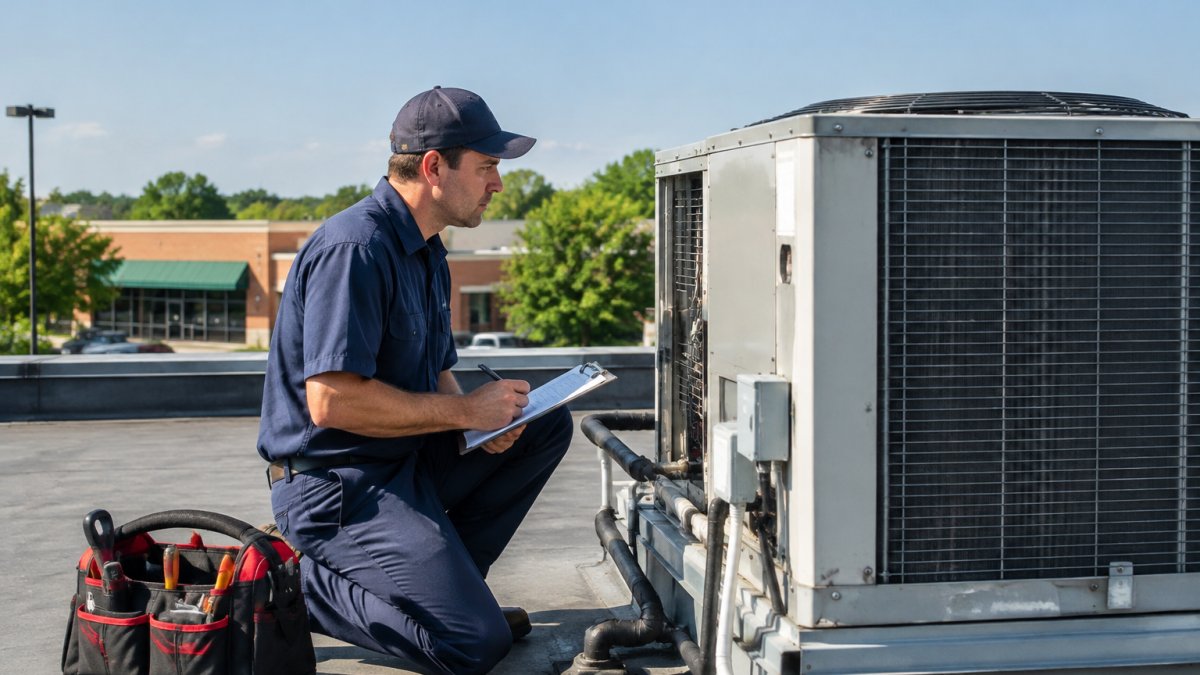
A commercial HVAC preventative maintenance checklist is the itemized list of tasks a technician completes at each service visit, signed and dated so you can track equipment condition over time. Ours covers eight categories, and we recommend you ask any service provider to work from something comparable.
- Replace or clean air filters; record pressure drop
- Inspect blower wheel, belts, and bearings; lubricate per spec
- Clean evaporator and condenser coils
- Flush condensate drain and test the pan and float switch
- Check electrical connections, contactors, capacitors, and amp draw
- Verify refrigerant charge and inspect lines for leaks
- Test thermostat calibration and controls sequence
- Confirm airflow at supply and return registers
You can see the full scope of what our HVAC maintenance service includes before you commit to a program.
A Seasonal Maintenance Calendar for Small Businesses
Timing matters as much as the task list. Cooling equipment should be inspected in spring before the first heat wave, heating equipment in early fall before the first cold snap. Scheduling in the shoulder seasons keeps you out of the emergency queue, which is exactly where labor shortages bite hardest. Industry reporting from Simpro's 2026 HVAC industry statistics flags labor availability as a persistent challenge, and the practical consequence is simple: the businesses that book early get served first.
Seasonal advice often stops at "spring for cooling, fall for heating." What follows is a working calendar organized by month, with each task tagged as either owner-safe (a manager or maintenance staffer can do it with basic tools) or technician-only (requires licensing, refrigerant handling, or electrical work). Print it, assign names, and put dates on a shared calendar.
Month-by-Month Calendar
| Month | Focus | Owner-Safe Tasks | Technician-Only Tasks |
|---|---|---|---|
| January | Winter reliability | Check filters monthly; clear snow and ice from outdoor units; verify freeze stats are set | Inspect heat exchanger for cracks; test safety controls and flame sensors |
| February | Pre-spring prep | Replace filters; clear condensate drain pans of debris; note any unusual noises | Check refrigerant charge; inspect contactors and capacitors |
| March | Cooling startup | Change filters; clear debris from condenser; confirm thermostat schedules | Clean condenser coils; verify compressor amp draw; test crankcase heaters |
| April | Cooling season begins | Check filters every two weeks during heavy use; keep return grilles unobstructed | Clean evaporator coils; flush condensate drain; verify refrigerant charge |
| May | Peak-load readiness | Log supply and return temperatures weekly; watch for short cycling | Inspect blower wheel and belts; lubricate bearings; check economizer operation |
| June | Peak load | Replace filters monthly; check condensate pan for standing water | Test all electrical connections; measure amp draw on compressors and fans |
| July | Peak load | Replace filters monthly; keep outdoor units clear of vegetation | Inspect coils for fouling; verify refrigerant pressures under full load |
| August | Peak load | Replace filters monthly; listen for new noises; log comfort complaints | Check contactors for pitting; test capacitors; inspect fan blades |
| September | Heating startup | Change filters; clear debris from flue and intake; confirm thermostat heat mode | Inspect heat exchanger; clean burners; test ignition and safety controls |
| October | Heating season begins | Replace filters; check for drafts around unit penetrations | Verify gas pressure; inspect flue draft; test limit switches |
| November | Heating reliability | Replace filters; keep outdoor units clear of leaves | Lubricate blower bearings; check belts; measure temperature rise |
| December | Year-end review | Replace filters; review service log for recurring findings | Full system inspection; document equipment condition for next year's budget |
How to Use the Calendar
Two rules make the calendar work. First, book technician visits in the shoulder months (March-April and September-October) before the peak-season queue forms. Second, assign every owner-safe task to a named person with a recurring calendar reminder; unassigned tasks do not get done. A common pattern is that filter changes slip first, and clogged filters are the leading cause of avoidable blower and compressor strain.
Watch out: Do not let staff open electrical panels, handle refrigerant lines, or clean coils without training and proper lockout procedures. The owner-safe column is deliberately limited to filters, visual checks, debris clearing, and thermostat settings.
Adjusting the Calendar to Your Business
The calendar above assumes a typical small commercial building with year-round occupancy. Adjust it in three ways:
- High-occupancy or 24/7 operations (restaurants, clinics, server rooms): move filter changes to monthly year-round and add a mid-season technician visit.
- Seasonal businesses (retail with slow summers, offices with peak heating): shift the heavy inspection to the month before your busiest period, not the calendar season.
- Older equipment (past 10-12 years): add a second technician visit in each peak season and ask for a written remaining-life estimate at the fall inspection.
If you want the technician-side checklist that pairs with this calendar, see the commercial HVAC preventative maintenance checklist above.
What Commercial HVAC Maintenance Cost Looks Like
Commercial HVAC maintenance cost depends on system count, system size, equipment age, and how much of the work is preventive versus corrective. A single rooftop unit on a small storefront sits at the low end; a multi-zone system across several suites sits well above it. Pricing also varies by region and by whether you choose two visits a year or a monthly schedule.
Pricing depends on the size, equipment, and visit frequency of each property, so current pricing and a quote are best requested directly from T. Gomes Heating & Cooling.
The Three Cost Buckets
Every commercial maintenance budget has three parts, and confusing them is the most common budgeting mistake small owners make:
- Planned maintenance (predictable). The service agreement: scheduled visits, inspections, filter changes, coil cleaning, and adjustments. This is the line item you can budget to the dollar.
- Corrective repairs (semi-predictable). Parts and labor for failures found during maintenance. A well-run plan converts most of these into small, scheduled fixes rather than emergency calls.
- Emergency and replacement (unpredictable). After-hours calls, compressor or heat exchanger replacement, and full system changeouts. This is the bucket that wrecks a budget, and it is the one maintenance is designed to shrink.
How Quotes Are Built
Most commercial providers price a service agreement using four inputs:
- Unit count and type. Rooftop package units, split systems, mini-splits, and exhaust fans each carry different service times.
- Tonnage and complexity. Larger systems and multi-zone controls take longer per visit.
- Visit frequency. Two visits a year is the baseline for most small commercial systems; quarterly or monthly schedules cost proportionally more but catch problems sooner.
- Scope inclusions. Filters, belts, and minor parts may be included or billed separately. Ask which.
A Simple Budget Formula
Rather than guessing, budget maintenance as a percentage of replacement cost. A commonly used planning approach is to budget a portion of your HVAC equipment's replacement value each year for maintenance, with a larger share for older equipment. Your provider can help you estimate the figure for your building.
To translate that into a per-square-foot figure, divide your annual maintenance spend by your conditioned square footage. Tracking that number year over year is one of the most useful benchmarks a small owner can keep, because it tells you whether a plan is getting more expensive because the building is aging or because the provider is padding visits.
Comparing Plans on More Than Price
A lower annual price is not automatically the better deal. Compare plans on five points:
- Visit frequency and tasks per visit (ask for the written task list).
- Priority response time in hours, not adjectives.
- Parts and labor coverage, what is included versus billed.
- Filter responsibility, who supplies and who installs.
- Reporting, do you get a written condition report after each visit?
If you want to understand whether the spend pays back, our breakdown of whether a commercial HVAC maintenance service is worth it walks through the return case in detail. And if you are comparing plan tiers side by side, this comparison guide to HVAC maintenance plans lays out what each tier typically includes.
Choosing Maintenance Frequency and Service Agreement Scope
Two visits a year suits most small commercial systems; heavy-use kitchens, server rooms, and buildings with sensitive inventory often need quarterly or monthly attention. The right service agreement scope should specify visit frequency, tasks per visit, priority response time, parts and labor coverage, and what triggers a separate charge. Get all five in writing.
What most owners miss is the response-time clause. A plan that promises "priority scheduling" without a number is marketing. Ask for hours, not adjectives. If you are comparing plans side by side, this comparison guide to HVAC maintenance plans lays out the options and what each tier typically includes.
HVAC Service for Property Managers: Multi-Site and Lease Rules
HVAC service for property managers has to solve a problem single-site owners never face: consistency across buildings and clear lines of responsibility. Your lease language decides who pays for filter changes, who authorizes repairs above a set dollar amount, and who holds the service contract. Multi-site service also demands one point of contact and a shared service log, so a technician arriving at building three knows what happened at building one.
For a deeper walkthrough of multi-site scheduling and lease responsibilities, read our HVAC service planning guide for property managers.
Preventing Downtime and Measuring Maintenance Results
Downtime prevention comes down to two habits: tracking equipment condition visit over visit, and acting on small findings before they become failures. Ask your provider for a written report after every service visit listing what was found, what was corrected, and what needs watching. Over a year, that log tells you whether filters are loading faster than expected, whether a compressor is drawing more amps, and whether a unit is approaching the end of its service life.
Predictive maintenance using connected sensors and real-time data is gaining attention in the trade, per Lessen's reporting on HVAC maintenance trends, though adoption among small commercial properties remains limited. The fundamentals still do the work: clean coils, clear drains, tight connections, and a schedule someone actually follows.
Booking Your First Small Business HVAC Service Visit
Start with one walkthrough. We will inventory your equipment, note its condition and age, and give you a written scope with pricing before any work begins. Our team is licensed and insured.
Call T. Gomes Heating & Cooling or use our contact page to schedule your first visit.
Frequently Asked Questions
What is the $5,000 rule for HVAC systems?
The $5,000 rule is a rough repair-or-replace guideline: multiply the age of the unit by the cost of the repair, and if the result tops $5,000, replacement is usually the better call. A 12-year-old unit facing a $450 repair scores 5,400, which points toward a new system. Treat it as a starting point, not a verdict. Equipment condition, refrigerant type, and how long you plan to stay in the building all matter just as much.
How often should a small business schedule professional HVAC servicing?
Most small businesses do well with two service visits a year: a cooling inspection in spring and a heating inspection in fall. High-use spaces like restaurants, salons, and server rooms may need quarterly visits because filters load faster and equipment runs longer. Single-system offices with light occupancy can sometimes stretch to one comprehensive annual visit. Your technician can confirm the right interval after the first inspection, based on equipment age and filter condition.
What drives commercial HVAC maintenance cost for a small business?
Commercial HVAC maintenance cost depends on system size and complexity, the number of units, how many service visits your agreement includes, and whether the work happens on a roof or in a tight mechanical closet. Equipment age matters too, since older systems need more attention. Because every building is different, ask for a written scope and quote rather than a per-unit estimate. That way you compare the same tasks across providers.
What should be included in an HVAC maintenance plan?
A solid plan covers filter replacement, coil cleaning, condensate drain clearing, electrical component inspection, blower and fan checks, refrigerant level verification, and a written report on equipment condition. It should also state how many service visits you get, response time for repair calls, and whether parts or labor are discounted. For property managers, add multi-site scheduling and per-unit documentation so lease and warranty obligations stay satisfied.